|
Pentecost Vision Weiz
We
are a community of people who live according to Christian teachings. We
are inspired by the shared vision of a revived and new Pentecost.
Our vision
is people who are led by God's spirit.
Pentecost is the
experience of
God's spirit. We define our Christian aim as a process of growing into
a life filled with God's spirit.
We try daily to
create space for God's spirit. In this way we can become open and trust
that we can meet new challenges.
We foster small
communities in which life and faith are shared.
Our vision
is people who show solidarity.
We live in a time of
great
change. In many fields of our society solidarity is threatened. We are
confronted with the challenge of reflecting on our doings and to grow
in solidarity.
Our motto is, " The
more spirituality, the more solidarity." We try to live the unity of
spirituality and solidarity
We are committed to
different solidarity initiatives
Our vision
is a church that speaks a new language.
The miracle of
pentecost was that
people were able to understand the apostles each in their own
languages. We are looking for such a "new language" that people
nowadays understand.
While trying to find
such a
language, we have already launched the "Weizer Pfingstereignis"
(Pentecost Event in Weiz), the "Spiritueller Weg" (Spiritual Path) and
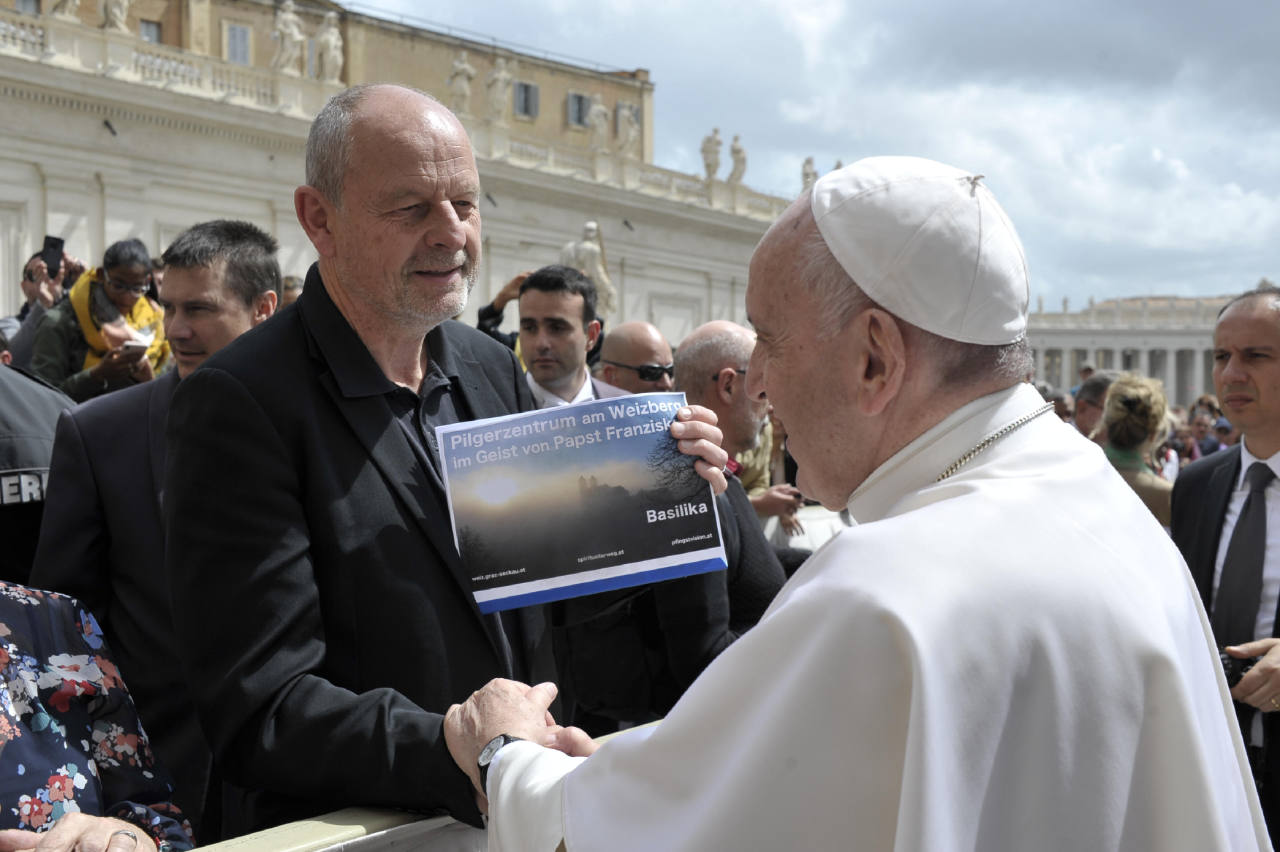
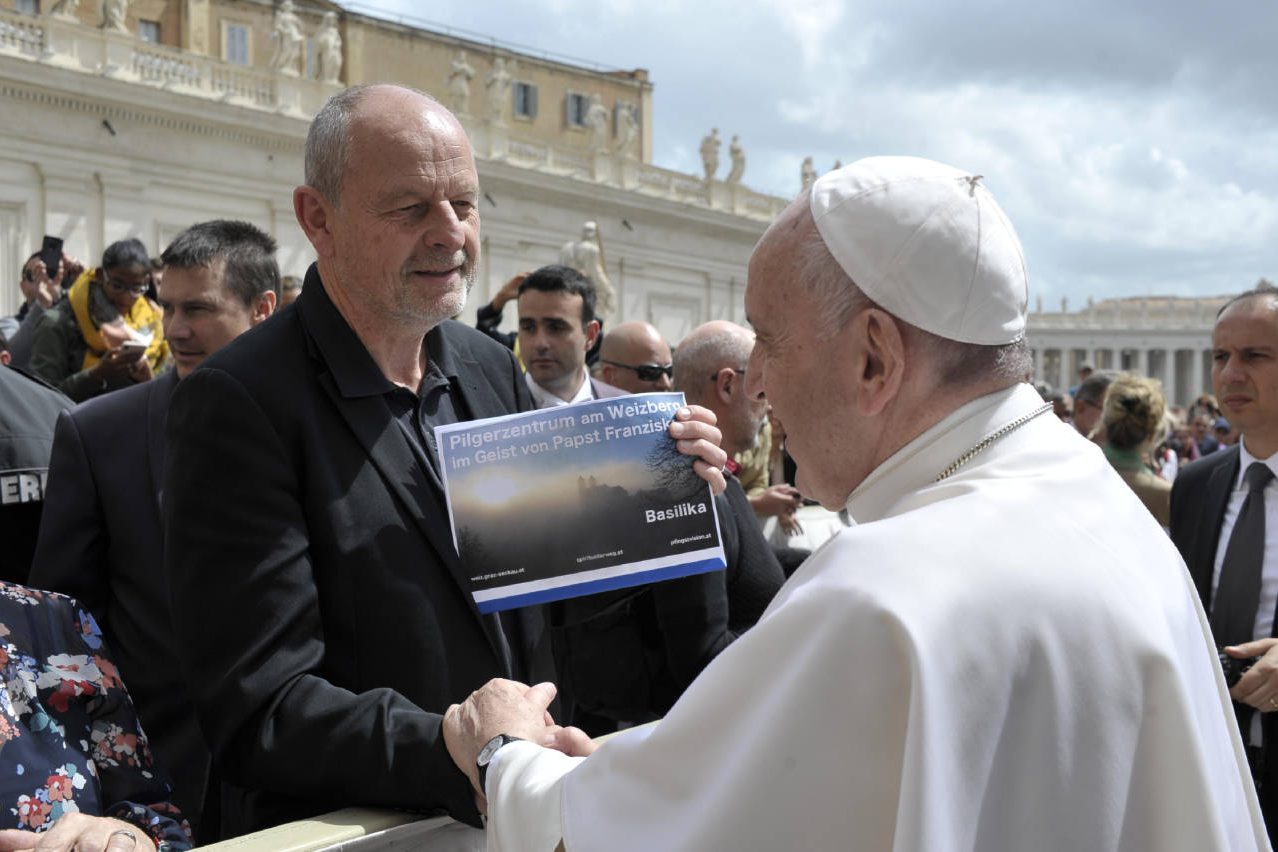
various encounters with art. With the same aim we would like to
transform the Weizberg, the location of these events, into a spiritual
centre.
We are an
ecumenically oriented
community. We look for ways to renew our church. We regard ourselves as
an "offensive midway" in the midst of inner church reforms.
The
Development of our Movement
I.
Where do we come from?
The conception of
our movement
was a communal vision. This vision was stated for the first time at
Pentecost in 1989 by young people from Weiz, in their musical about
Martin Luther King. It was a vision of a renewal of our church. This
was the beginning of a shared path. Every year since then young people
have met in Weiz at Pentecost. Meditation days for young people have
been the spiritual basis. With the solidarity commitment of the young
people, the groups "Axe" and "Christina lebt" have been founded. At
Pentecost 1995 this vision was written down in 10 points, which has
become known as the "Weizer Pfingstvision" (Pentecost Vision) outside
of Weiz. Cardinal Dr. Franz König was the first one to sign.
At
the same time more and more adults were becoming involved in the
realization of this vision. The result of these youth gatherings was
the "Weizer Pfingstereignis" (Pentecost Event in Weiz) with a varied
cultural-spiritual-solidarity programme. Pastoral seminars now formed
the spiritual basis of this movement. The well-known theologian Dr.
Paul M. Zulehner became an important companion for our movement. Famous
people like P. Henri Boulad, P. Iswar Prasad or Sr. Ishpriya also
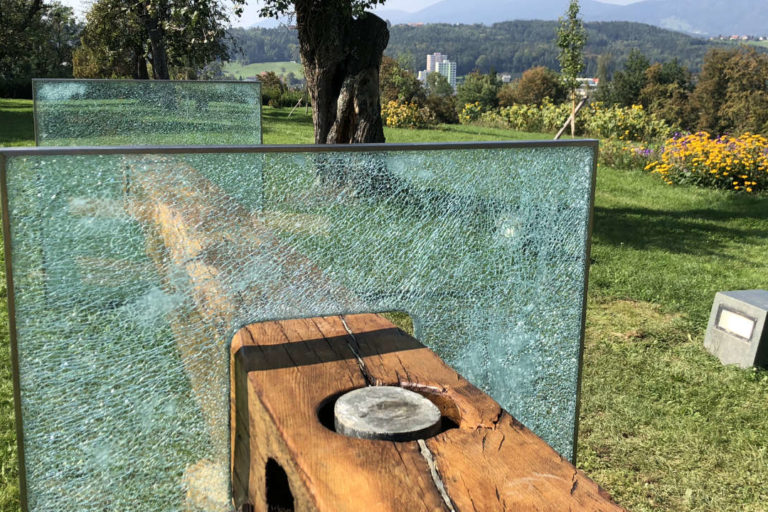
provided important impulses. In 2001 the Spiritual Path was created in
Weiz, as a big common project. In the course of time, the encounter
with modern art has become another feature of our movement. In 2003 a
Pentecost Symposium for leaders took place for the first time. We
envision our movement as an open one in a dynamic environment.
II.
Who are we?
We are a community
of people who lead their lives according to Christian teachings. We are
led by the vision of a new Pentecost.
Our vision is people who are led by the Holy Spirit
Our vision is people who show solidarity
Our vision is a church as a community that speaks a new language
Our logo is the Tau, which is a biblical symbol of salvation. Francis
of Assisi used it 800 years ago as a sign of identification for his
movement, which started with a vision. For us it symbolizes our motto,
"The more spiritual, the more solidarity."
III.
What is our basis?
We live at a time of
profound
changes. Our church also finds itself in a position of epochal
transitions. We face the challenge of rethinking and reshaping the
present. Our vision of a "New Pentecost" gives us orientation as we
face this challenge.
1.
Pentecost
Pentecost is the
experience of God's renewing spirit. Pentecost is a sign of God's
benevolence towards humanity, which is a present that can neither be
predicted nor organized. It is a renewal, an awakening from inside.
Pentecost can also be seen as the creative power of God that becomes
visible through mankind's doings as well as a personal-spiritual
process of growing into a life in the Holy Spirit. In Christian
tradition, Pentecost is the 50th day after Easter. It is the completion
of Easter: something completely new is beginning. In this sense
Pentecost is the beginning of a new person and hence the beginning of a
new humanity.
2.
"New Pentecost"
The term "New
Pentecost" comes from Pope John Paul XXIII. He associated it with the
hope that a "New Pentecost" would begin with the Second Vatican
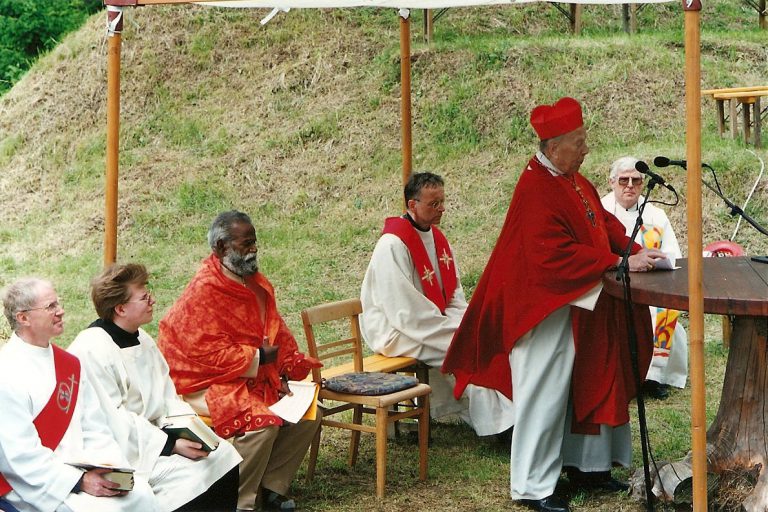
Council. In his Pentecost sermon in Weiz, cardinal Dr. Franz
König stated, "I expect a new Pentecost from your meetings in
Weiz." The hope is alive. It lives in every one of us. If we daily
create space for the Holy Spirit, we will be open and will be able to
engage trustingly in new ventures. The miracle of Pentecost was that
people from different nations and speaking different languages were
able to understand the apostles each in their own languages and thus
found a way to God. We are looking for this "new language," so that
people nowadays may understand us. Only if our doings reflect our
spirit, will our words be believable. The variety of different
languages can then become a blessing.
3.
Pentecost Vision and Spirituality
In an age of exact
figures and balance sheets as well as fragile biographies, we believe
in the experience of an ever increasing mystery of God. In accordance
with the theologian Karl Rahner, we believe that "the Christian of the
future will be a mystic. Someone who has either experienced something,
or he will cease to exist." The future of the church will be spiritual
people who have deliberately decided to live as Christians because of a
mystic experience.
4.
Pentecost Vision and Solidarity
The Pentecost Vision
is based on the principle of the unity of spirituality and solidarity.
"Whatever you did for one of the least of these brothers of mine, you
did for me." (Matthew 25:40) Thus our motto is: "The more spiritual,
the more solidarity." In biblical terms we regard ourselves as light
and salt of the world, that is to say, we want to create and maintain
the quality of life for others and we want to remedy abuses.
5.
Pentecost Vision and the Church
The Pentecost Vision
is an ecumenically oriented movement. We are trying to enrich the life
of our Catholic and Protestant parishes. We see the structure of the
parish and the congregation as an important basis of our work. In our
parish in Weiz, we launched the initiative of a Parish Council. We
don't limit our work to the region of Weiz alone, but we want to spread
the spirit of the Pentecost vision outside of Weiz as well. We regard
ourselves as an "offensive midway" in the midst of inner church
reforms. We focus more on commitment rather than on words.
6.
Pentecost Vision and Young People
The beginning of our
movement was strongly shaped by young people. Many initiatives and
ideas continue to be developed by the enthusiasm of young people.
7.
Pentecost Vision and Art
We respect
contemporary art as an unprotected and thus ever more truthful form of
a creative perception of our world and our time. The encounter with art
is part of our endeavours to find a new language. Art creates more
concentrated, not ordinary spaces in which humans can find a way to
their true identity and to others. Hence, art is related to
spirituality.
8.
Pentecost Vision and Leaders
In their fields of
work leaders are important focal points and "mulitpliers" of relevant
possibilities for the future. The Pentecost Vision also aims at a
social renewal. Therefore, leaders are important dialogue partners.
Leaders' cross-linked ideas can offer great and renewing input. Our
Pentecost Symposium initiative is based on this conviction.
9.
Pentecost Vision and Personal Commitment
The Pentecost Vision
relies on the freedom and responsibility of each individual person.
First, it is necessary to live one's Christian identity in one's own
social environment. Spirituality must show itself in everyday life.
Every person shapes the Pentecost Vision with her/his unique and
special gifts. The purpose of the Pentecost is not primarily to
organize something; the "being" is more important than the "doing".
IV.
What do we do?
♦ We take
over various tasks in the different parishes and congregations.
♦ We hold
pastoral seminars to provide spiritual experience for the people.
♦ We
organize spiritual exercises, spiritual seminars and journeys to
Assisi, Rome and Benares.
♦ We tend
the Spiritual Path in Weiz.
♦ We
support the
association "Christina lebt" and are involved in the integration and
home care of handicapped people in around Weiz.
♦ In the
group "Axe" we
support Weiz's former chaplain Günther Zgubic who is now
responsible for the pastoral care in Brazil's prisons.
♦ We
organize and arrange the annual Pentecost Event in Weiz.
♦ We are
in constant contact with artists and integrate art into our work.
♦ We
foster small communities in which faith and life are shared.
V.
What structure do we have?
We deliberately have
a very open
and free structure. There is no membership; everyone that shares our
vision of a new Pentecost can join us for prayer and commitment. Our
movement is led by the "Team 7" which meets monthly. All groups,
initiatives and teams that take part in the Pentecost Vision are
represented in the so-called "Circle 30".
Our Organisation
The Weiz Pentecost Vision is run collectively, trusting in the guidance
of the Holy Spirit. "For where two or three come together in my name,
there am I with them." (Matthew 18,20)
"Conciliar Night":
Everyone who feels spiritually connected with the Pentecost Vision has
the possibility to participate in the "Conciliar Night." Goals of this
night are making connections, acquiring a deeper spiritual
understanding and seeking the right way in life together. Other
characteristics of this night are openness and diversity.
Circle 30: All of
the groups and initiatives of the Pentecost Vision as well as the
Catholic and the Protestant parish priests are represented in this
group. This circle of leaders meets five times a year and consists of
approx. 30 members. Membership changes are decided amicably within the
Circle 30.
Team 7: It consists
of 12 people,
approx. the same number of men as women, who meet each other once a
month. As the team in charge, it is responsible for overseeing the
organisation of the Pentecost Vision. Membership changes are made
amicably within the team.
Supervisor and
Coordinator: She/He is appointed to this position by the Bishop. She/He
contributes her/his formation and leadership abilities to this office.
Through her/him - approved by the Bishop - it is ensured that the
movement is embedded in the local parish.
VI.
What do we want?
♦ We want
to form our social and personal lives out of a spiritual relationship
to God.
♦ We want
to talk about our spiritual experiences.
♦ We want
to support minorities, outsiders and disadvantaged people.
♦ We want
to look for an active correlation between different groups of our
society.
♦ We want
to find ways to "live" church under today's circumstances.
♦ We want
to build up the church of the future.
♦ We want
to have courage for new things.
♦ We want
to play a part in spreading the Gospel.
♦ We want
to appeal to people in many different ways.
♦ We want
to appreciate the value of diversity.
♦ We want
to invite people to join the way of the Pentecost Vision.
VII.
What are our emphases?
1. We increasingly
invite from outside of Weiz to the Pentecost Event in Weiz.
2. We promote the Spiritual Path as a modern path for pilgrims.
3. We help to develop the Weizberg into a spiritual centre.
4. We bring the spirit of renewal to our church.
5. We integrate the spirit of solidarity into our society.
|